




Introduction to various drilling methods of rotary drilling rig
An outstanding machine operator should always be aware of the type and strength of the geology being drilled into at any given moment, and understand which drill rod and tool to use, as well as the most effective drilling method. Only by doing so can the operator maintain control of the operation, minimize the load, reduce wear and tear, and achieve the fastest possible drilling progress.
Based on geological conditions, rotary drilling rigs can be categorized into four drilling methods: cutting, crushing, dialing, and grinding.
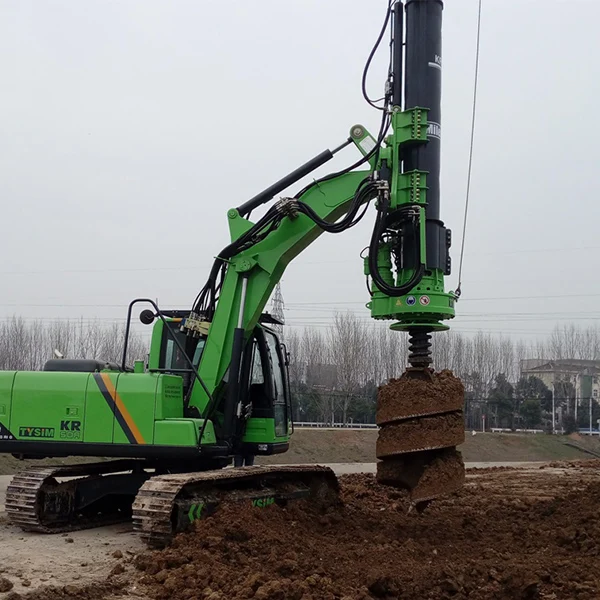
Firstly, cutting drilling involves the use of bucket teeth and double-bottom sand-scooping buckets paired with friction-type drill rods. This method is suitable for drilling into strata with relatively stable and low resistance, such as mud, silt, and sand layers with a general geological strength of up to 400 kPa. By rotating the bucket teeth for cutting, resistance can be reduced, thereby increasing the drilling speed.
Secondly, crushing drilling employs cutting teeth and mostly uses double-bottom rock-penetrating buckets. Depending on the geological strength, friction or mechanical lock drill rods can be configured. This method can be used to drill into strata with strengths ranging from 500 kPa to 1000 kPa, such as sandy gravel, mudstone, sandstone, shale, and moderately weathered rock. Crushing drilling is achieved by applying pressure to transmit force to the alloy points on the cutting teeth.
Thirdly, dialing drilling can utilize both double-bottom sand-scooping buckets and double-bottom rock-penetrating buckets, and can also be used in conjunction with Bauer teeth. As the type of geology varies, the drilling method needs to be adjusted accordingly. For example, in pebble layers, due to the irregular arrangement of pebbles, cutting and crushing are not feasible. Instead, dialing drilling can be used, where the drill rod is suspended by the main winch and the pebbles are dialed with the tip of the bucket teeth. After loosening the pebbles, the bucket is lowered in a floating manner. This method avoids the strength and vibration of the pebbles.
Lastly, grinding drilling employs rock-penetrating cylindrical drills and toothed axis drills, paired with mechanically locked drill rods. It is used to drill into rock strata with compressive strengths ranging from several MPa to several tens of MPa, typically for rock-socketed piles. Drilling is achieved through circumferential cutting and grinding into the rock with the cylindrical drill, or through grinding with the toothed axis drill. Depending on the type, strength, brittleness, and fissures of the rock stratum, there may be a possibility of crushing.
More piling foundation information focus on LIMTA.